Contents
- ·The short version
- 1What actually builds confidence?
- 2Does taking care of your body make you more confident?
- 3How do you set goals that grow confidence?
- 4How do you look confident before you feel it?
- 5What do you do with the inner critic?
- 6Why does helping someone boost confidence?
- 7Is confidence different at work than socially?
- ·Questions you might have
- ·When not to
- ·Your move this week
You get more confident by collecting results that show you can do hard things, not by waiting for a feeling. Look after your body, set small goals you can finish, help someone each week, and practice a clear first impression. Habits will not fix depression or heavy anxiety, which need a professional.
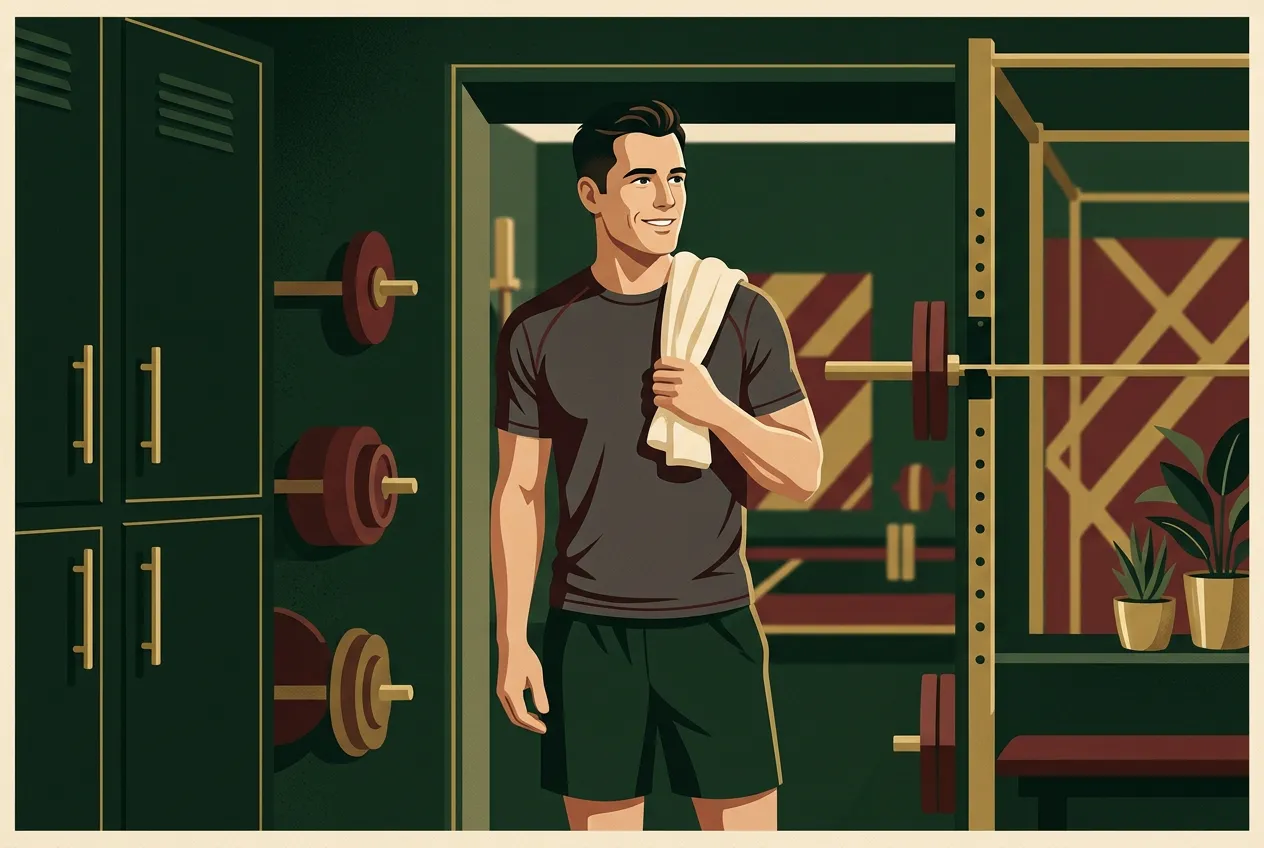
Nobody arrives fully charged. You build it by doing the thing before you feel ready.
You rehearse the perfect line in the shower, then it dies the second the room gets real. That gap between practiced and real is where a lot of men get stuck.
Learning how to be more confident as a man does not mean building a new personality. It means finishing small, real things until you trust yourself when it counts.
The short version
- Finish hard things yourself: in one large teen survey, feeling you were mastering things was the strongest link with belief in your own ability.
- Sleep, train and dress in clothes that fit, so you stop fussing over how you look.
- Set one goal you can finish this week, so you can see a clear result.
- Greet people warmly and speak clearly: a simple first thirty seconds probably calms the nerves.
- Label a harsh thought as the critic talking, not a fact, and take your next step.
- Help someone this week. In one six-week study, kindness to others lifted well-being more than treats for yourself.
- Use the same habits at work and socially: at work a win is owning a problem, socially it is saying something real.
What actually builds confidence?
Mostly doing hard things and finishing them. In a survey of 9,221 Norwegian teenagers aged 13 to 16, the strongest link with self-efficacy, which means belief in your own ability, was feeling that you were mastering things.
Support from friends and from parents showed a much weaker link. The survey is a snapshot of teenagers and does not prove cause, so treat it as a hint, not proof, for adults.
It seems that repeating positive phrases or picturing success works best as rehearsal for doing the thing, not as a replacement for it. Our guides to affirmations and visualization cover how. If hesitation stops you from starting, choose the smallest first move; our guide to how to stop hesitating helps.
Start with the body you live in.
Does taking care of your body make you more confident?
A little, mostly by removing distractions. Sleep, training, food you respect and clothes that fit mean less self-conscious fussing when you walk into a room. You are not buying confidence, you are clearing away friction.
A review of 113 studies of adults found that exercise raised global self-esteem by a small amount on average, with larger gains for people whose physical fitness actually improved. A fair guess is that body-based confidence builds gradually rather than arriving as a single workout high.
If the mirror is the blocker, start by washing, grooming and wearing one outfit that fits. Our guides to a hygiene routine and style basics cover the details.
- Protect a sleep window you can keep four nights a week.
- Move hard enough to feel it three times a week.
- Wear one outfit you already know fits, instead of debuting new clothes on a day that matters.
Then give yourself wins you can count.
How do you set goals that grow confidence?
Pick one specific goal you can finish this week. A vague goal like "get more confident" gives you nothing to check. Goal-setting research focuses on specific, difficult goals, and it seems a clear target turns effort into a result you can see.
Write the goal down and tell one person. Take the first step today, celebrate when you finish, then pick the next goal.
- One skill goal, such as sending the email, finishing the set or opening the conversation.
- One social goal, such as saying hello to three new people at one event. Our guide to stop being awkward has more ideas.
- One recovery goal if you are rebuilding after a hit, such as writing down what went wrong and one fix. Our guide to inner confidence has the longer version.
“I'm finishing [specific goal] by [day]. Ask me Friday if I did it.”
A product launch I owned slipped, and I spent the week before the retro dreading that meeting more than the actual fix.
The win wasn't the patch. It was standing up first and naming what I'd missed before anyone else had to. Nobody piled on — the dread had been worse than the room.
Mindset shows up when you meet people.
How do you look confident before you feel it?
By making your first thirty seconds simple. Smile when it fits, hold steady eye contact, and give a handshake that matches the room. Speak so the back row could hear you without shouting, and wear comfortable clothes instead of a costume.
At work, prepare the opening of a meeting with one clear point and one question. In social rooms, talk early. Our guide to going out alone shows how.
You: Sorry — um — I know this is dumb, but…
You: Good to meet you — I'm __. What brought you in today?
Them: A friend dragged me. You?
You: Same, honestly. Glad I came.
When your thoughts turn mean, change what you feed them.

What do you do with the inner critic?
You will not delete every bad thought, but you can refuse to treat it as a verdict. Spend less time with people who put you down, and spend your evenings making something, like cooking a meal or building a shelf, instead of scrolling through your flaws.
If your anxiety is clinical, do not tough it out alone: see a professional, and our anxiety post covers the basics. For an ordinary slump that is not clinical, our guide to how to overcome a lack of confidence goes further.
- Name the thought out loud: "that's the critic again, not a fact."
- Cap the replay: take one honest look at what went wrong, not ten.
- Make something small today, because the critic has less to say while you are busy.
“Maybe that's true, maybe it isn't. Either way, my next step is the first one on my list.”
Helping others pulls you out of the spiral.
Why does helping someone boost confidence?
Probably because it shows you that you have something to give, though the study below measured well-being, not confidence. Listen, offer advice only when someone asks, and do one unpaid helpful thing a week.
In a six-week experiment with 473 people, some were told to do acts of kindness for others or for the world. They gained more in psychological flourishing, a broad measure of well-being, than people told to be kind to themselves or to do a neutral task. People assigned self-focused acts did not improve compared with the control group.
“Hey, I've got twenty minutes. Want a hand with that?”
Is confidence different at work than socially?
Not in method, only in what counts as a win. Learning how to be more confident at work means hitting deadlines and owning problems in front of the people who control your paycheck. Learning how to be more confident socially means showing up, saying something real, and staying in the room after it gets a little awkward.
We think confidence is tested hardest in the ten seconds after a hit, such as a project picked apart or a joke that falls flat. Recover out loud in that window instead of going quiet.
- At work, restate the critique in one sentence before you respond, so the other person sees you are listening, not defending.
- At work, ask one clarifying question before you fix anything. It buys you a beat and shows you took the point seriously.
- Socially, if a line or joke flops, do not explain it. Move the conversation forward in your next sentence.
- Socially, practice by starting short chats with coworkers and neighbours, and by inviting one acquaintance to do something. Our guides to small talk and making friends as an adult go deeper. For dating nerves, ask one person out in plain words; our guide to how to ask a girl out shows how.
Boss: This section doesn't work. Did you even test it?
You: Uh, I mean — I thought it was fine, but I guess...
Boss: This section doesn't work. Did you even test it?
You: Got it — sounds like the edge case broke it. I'll retest and send you the fix today.
Restate the problem, own it, and name the next step. Skip the apology tour and the excuses.
Questions you might have
Isn't confidence just genetics or childhood?
A fair guess is that early life shapes where you start but does not fix where you end up. You can keep adding results as an adult, and each goal you finish gives you new evidence about what you can do.
What if I fail publicly?
A public failure gives you information you can use, and people probably remember how you recover more than the stumble. Our guide to handling rejection covers the dating version.
Can't I just fake it with power poses or confident body language?
Posture and eye contact are worth practicing because they shape how you come across. But the viral idea that a two-minute power pose changes your hormones and risk-taking did not hold up: a replication with a large sample of men and women found no effect on either.
Confidence built on a pose lasts as long as the pose. Confidence built on finished goals follows you out the door.
When not to
Fake arrogance is not confidence. If "confidence" means ignoring feedback you need, stop.
Depression and clinical anxiety need more than a list of habits. If your life is shrinking, talk to a doctor or a therapist.
Your move this week
- Finish one small goal you can measure by Friday.
- Practice the clear first thirty seconds once this week: a smile, steady eye contact and a simple opener like "Good to meet you, I'm __."
- Help one person without announcing it.
Share this guide
Cite this page
Nicolas Tailor. "How to Be More Confident: A Practical Guide." SuaveWay, 4 October 2026, https://suaveway.com/blog/how-to-be-more-confident/.
Copy for Reddit
# How to Be More Confident: A Practical Guide

You get more confident by collecting results that show you can do hard things, not by waiting for a feeling. Look after your body, set small goals you can finish, help someone each week, and practice a clear first impression. Habits will not fix depression or heavy anxiety, which need a professional.

The short version:

- Finish hard things yourself: in one large teen survey, feeling you were mastering things was the strongest link with belief in your own ability.
- Sleep, train and dress in clothes that fit, so you stop fussing over how you look.
- Set one goal you can finish this week, so you can see a clear result.
- Greet people warmly and speak clearly: a simple first thirty seconds probably calms the nerves.
- Label a harsh thought as the critic talking, not a fact, and take your next step.
- Help someone this week. In one six-week study, kindness to others lifted well-being more than treats for yourself.
- Use the same habits at work and socially: at work a win is owning a problem, socially it is saying something real.

From SuaveWay: https://suaveway.com/blog/how-to-be-more-confident/