Contents
- ·The short version
- 1What is the difference between nice and a Nice Guy?
- 2No More Mr Nice Guy summary: what does the book say?
- 3How do you spot the hidden contract in yourself?
- 4Do nice guys really finish last?
- 5How do you stop being a nice guy with women?
- 6How do you tell the truth without turning into a jerk?
- 7How do you ask for what you want instead of hinting?
- 8How do you say no without feeling guilty?
- 9Do you have to stop being kind?
- ·Questions you might have
- ·When not to
- ·Your move this week
To stop being a nice guy, stop doing favors as a silent trade for love, sex or approval. Say what you actually think, kindly, and ask directly for what you want, including a date. Keep the kindness itself: in dating studies women prefer kind men for relationships, so the bargain is what fails, not the kindness.

You help, you agree, you keep the peace. Somewhere underneath, you expect it to count for something, and when it doesn't, you feel resentful instead of saying what you wanted.
On r/NoMoreMrNiceGuy, a Reddit forum where men work through the book that named this pattern, one member described a relationship in which they bought the gifts and planned the trips. After the breakup: "I was so bitter at the fact that I did everything I could for her and she couldn't love me back for it."
That bitterness is the pattern, and it is fixable without turning into a jerk. Here is how it works, what the research says about nice guys in dating, and the words to use instead.
The short version
- Separate kindness from the performance: caring is healthy, caring at your own expense is the problem.
- Learn the three hidden trades in Robert Glover's No More Mr Nice Guy, so you can spot them in yourself.
- Treat resentment after a favor as a signal that you expected something you never asked for.
- Drop the myth that kindness loses: in studies it wins for relationships and loses ground only for casual sex.
- With women, say you're interested and suggest a plan, instead of hanging around hoping she notices.
- Give your real opinion in small moments first, warmly, so honesty is easy when it matters.
- Ask plainly instead of hinting: hints get misread, and people agree to requests for help more than you'd guess.
- Say no briefly and without a speech; people mind a turned-down invitation less than you'd expect.
- Keep helping people, but only where you'd still help if nothing came back.
What is the difference between nice and a Nice Guy?
A kind man helps because he wants to. A Nice Guy, in therapist Robert Glover's sense, acts the way he thinks people want so they will like him and meet his needs. Glover described the pattern in his 2003 book No More Mr Nice Guy, drawing on his own recovery and the men he saw in his practice.
Psychologists draw a similar line. Caring about other people is not linked to distress. Caring about others to the exclusion of yourself is, partly because it ties your self-worth to their approval and leaves your own needs neglected.
So the fix is not less kindness. It is kindness that doesn't depend on getting paid back.
The book gives the hidden bargain a name, and it is worth knowing the details.
No More Mr Nice Guy summary: what does the book say?
Glover's core idea is that Nice Guys run three unspoken deals, which he calls covert contracts. In our words: if I'm good, I'll be loved and wanted. If I meet people's needs without being asked, they'll meet mine without me asking. If I do everything right, life will go smoothly.
Nobody else agreed to these deals, so they rarely pay out, and the Nice Guy ends up frustrated and resentful. Glover's prescription is to set boundaries, face conflict, put your own needs on the list, build friendships with other men, and live with a purpose of your own.
His goal is what he calls the Integrated Male. That doesn't mean becoming not nice. It means accepting all of yourself, including your ambition, your rough edges and your mistakes, instead of hiding them to stay liked.
Glover says he found the pattern in himself first. In his early thirties, with one marriage over and a second in trouble, he joined a men's group and saw a therapist, at first hoping to get other people to change. He later recognised the same pattern in married clients and in single men stuck in the friend zone.
Knowing the theory is easy. Catching yourself in the middle of a contract is harder.
How do you spot the hidden contract in yourself?
Watch for resentment after a favor nobody asked you to do. Mental-health guides on people-pleasing describe the same chain: say yes when you mean no, and resentment builds toward someone who did nothing wrong.
The motive is often invisible until you look for it. One forum member did a lot for a stressed girlfriend to free up her time, partly hoping she'd want sex again. Looking back: "I didn't set out with this motivation but when I examine my motivations I can clearly see that this was the case."
- Think of the last favor that left you bitter afterward.
- Write down what you hoped to get back: thanks, affection, sex, a favor in return, or just less conflict.
- Notice whether you ever asked for that thing directly. If not, you found a contract.
- Before the next favor, ask yourself whether you'd still do it if nothing came back.
“If she never does anything back, would I still do this?”
If the answer is no, either say what you want or don't do the favor.
Many Nice Guys keep the contracts going because they believe kindness loses with women. The research says otherwise.
Do nice guys really finish last?
Mostly no for relationships, partly yes for casual sex. In a survey of 165 university women, more than half said nice guys have fewer sexual partners, and more than half also said they'd choose a nice guy over a bad boy as a date.
In two experiments, college women read a script of two men competing for a date and picked the kinder one more often, mostly for serious relationships. Looks mattered more for casual ones. A later study found the flip side: less agreeable college men had more casual sexual partners.
In another set of three studies, women rated kind, helpful men as more attractive and more desirable as dates, and being dominant without being kind did not make men more attractive on any measure. In a BBC survey of about 218,000 people, kindness and honesty ranked among the four traits people wanted most in a partner.
So the kindness can stay. What has to change is how you show interest.
How do you stop being a nice guy with women?
Say you're interested, out loud, and suggest a plan. Waiting to be noticed while doing favors is the first contract in action: be good enough and she'll eventually want you. Telling her lets her give you a real answer.
Then make choices on dates instead of deferring to her on everything. "Whatever you want" sounds easygoing, but it hands her all the planning and hides you. A clear suggestion she can say no to shows her who you are.
If she says no, thank her and move on for real: no extra favors, no waiting it out. Timing and wording for the ask itself, by text or in person, are in our guide on how to ask a girl out.
Her: what do you want to do friday
You: haha whatever you want, I'm easy
Her: what do you want to do friday
You: There's a Thai place on 5th I've wanted to try. 7:30?
Her: Yes! See you there
If you have been her friend for a while, say it plainly: "I like spending time with you, and I'd like it to be a date. Dinner Saturday?"
Showing interest is one kind of honesty. The everyday kind matters just as much.
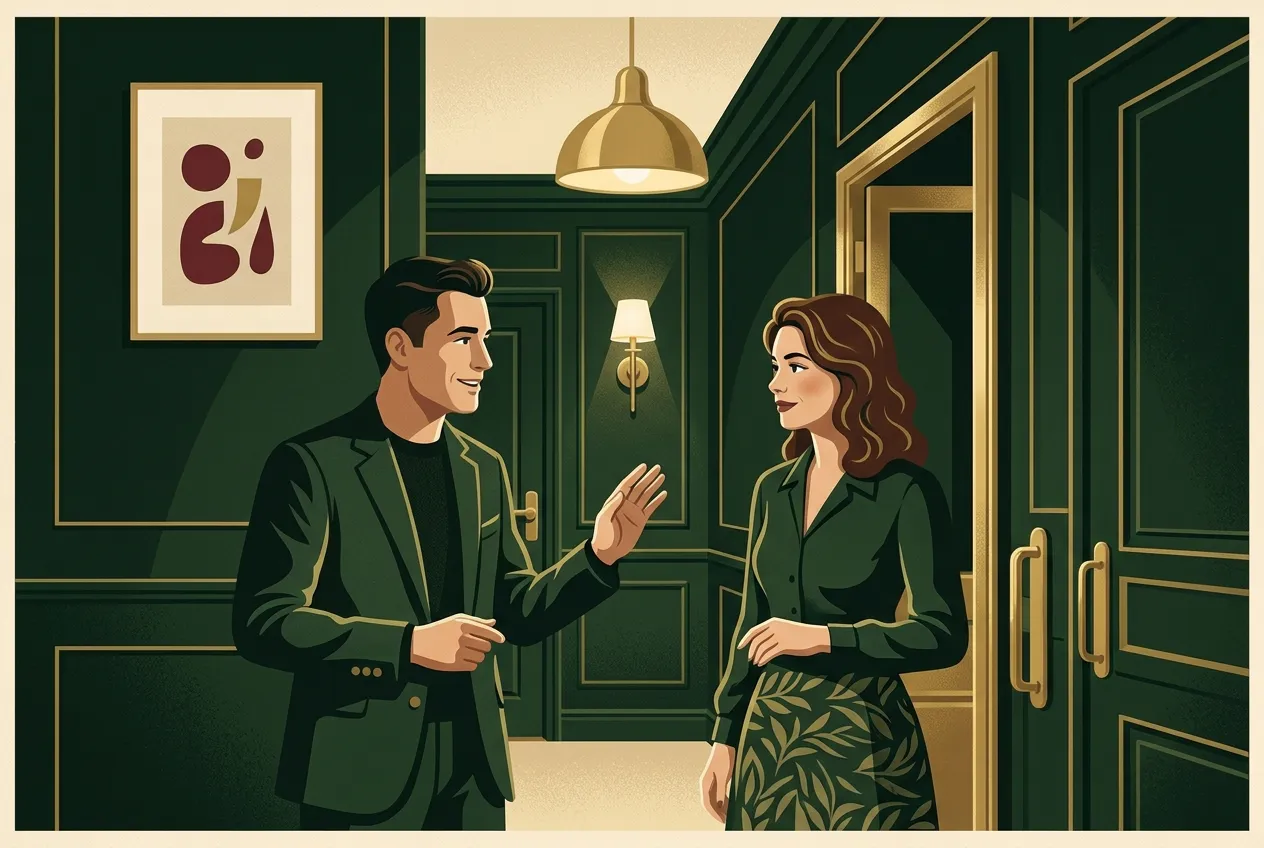
How do you tell the truth without turning into a jerk?
Say the true thing and stay warm while you say it. Harshness isn't the opposite of people-pleasing. It is just a different act, and it probably comes across as one.
Start with low stakes: a real opinion about dinner, a real reaction to a plan you don't love. Small honest moments make the big ones feel normal.
Your fear of how it lands is probably inflated. In one set of studies, people consistently underestimated how much a new conversation partner liked them, and the gap lasted for months.
Her: What do you think of the apartment?
You: It's fine, honestly whatever you like is great!
Her: What do you think of the apartment?
You: Honestly, the kitchen's too small for me. The one on Elm Street felt better.
Honesty handles the moment in front of you. Asking handles what you need from it.
How do you ask for what you want instead of hinting?
A hint protects you from a no, but it is easy to misread. One forum member ended a warm email to their wife with a hint about time alone together. In their words, "the line I put in at the end made her stressed out", and she wondered if the whole email was a lead-up to sex.
Direct asks work better than you expect. In studies of help requests, people underestimated by as much as half how often others would say yes. Dates are a different question, but we'd guess the same fear is at work: you expect a no more often than you'll get one.
A useful shape for a bigger ask, from one university counseling guide: show you see their side, state what you need in one sentence, and propose what happens next.
“I know work's been brutal. I felt let down when Friday got cancelled twice. Can we pick one night a week and keep it?”
Asking for what you want also means being able to turn down what you don't.
How do you say no without feeling guilty?
Keep it short, warm and honest, with no long apology and no invented excuse. A clinical guide on assertiveness recommends thanking the person for asking, giving one reason at most, and owning the choice rather than claiming you can't.
The guilt usually overestimates the damage. In recent studies on turning down invitations, people expected the other person to be more hurt and angry than they really were.
Saying no at work, or to someone who keeps asking, takes a few more tools, covered in our guide on being more assertive as a man.
“Thanks for thinking of me. I'm not going to help with the move Saturday; I've got plans I want to keep. Hope it goes smoothly.”
Only offer a raincheck ("Not this weekend, but I'd like to. How's the one after?") if you actually mean it.
None of this asks you to stop being generous.
Do you have to stop being kind?
No. Keep helping people, just stop sending an invoice afterward. A member of the forum put it simply: "You can still do all those things, but don’t do them with the expectation that you will then get something back."
Change slowly. Cleveland Clinic's advice on people-pleasing is to start small, and to notice when saying yes stops feeling like a choice and becomes a way to keep the peace.
Questions you might have
Women say they want nice guys and then date jerks. Why bother?
Partly true for casual sex, mostly false for relationships. In the studies above, kindness won for serious dating, and dominance on its own didn't make men more attractive.
So the answer isn't acting like a jerk. It's being kind and saying clearly what you want.
Isn't No More Mr Nice Guy a red pill book?
Not by its own terms. Glover says outright that the book doesn't teach men to be not nice, and his harsh words (dishonest, controlling, passive-aggressive) describe the hidden-trade strategy, not kindness.
The fair criticism is that it's one therapist's model, written about men. Nice Guy Syndrome is a self-help idea, not a diagnosis, and we found no trial that tests it.
What if people like me less when I'm direct?
A few might at first. One forum member described what happens the first time you say no: "People assume you're the one with the problem!!" That reaction probably comes from people who got used to your automatic yes.
Most people mind a turned-down invitation less than you fear, and they like you more after a conversation than you assume.
I've already read No More Mr Nice Guy. Now what?
Use it as a mirror, then practice: one honest opinion this week, one direct ask next week. The book names the pattern well. Only repetition changes it.
When not to
Some yeses are right. A reasonable request from your boss, or a friend in a real crisis, calls for help, not a speech about boundaries. And don't confess feelings to a woman in a relationship to collect on years of friendship: that is the contract again.
Directness is not permission to be cruel or to unload every opinion. If people-pleasing comes with depression, anxiety or a hard childhood, a therapist will get you further than any guide or book.
Your move this week
- Write down the last favor that left you bitter, and what you hoped to get back.
- Give one honest opinion today that you'd normally soften into nothing.
- Ask directly for one thing you'd usually only hint at, including a date if there's someone you like.
Share this guide
Cite this page
Nicolas Tailor. "How to Stop Being a Nice Guy." SuaveWay, 6 October 2026, https://suaveway.com/blog/how-to-stop-being-a-nice-guy/.
Copy for Reddit
# How to Stop Being a Nice Guy

To stop being a nice guy, stop doing favors as a silent trade for love, sex or approval. Say what you actually think, kindly, and ask directly for what you want, including a date. Keep the kindness itself: in dating studies women prefer kind men for relationships, so the bargain is what fails, not the kindness.

The short version:

- Separate kindness from the performance: caring is healthy, caring at your own expense is the problem.
- Learn the three hidden trades in Robert Glover's No More Mr Nice Guy, so you can spot them in yourself.
- Treat resentment after a favor as a signal that you expected something you never asked for.
- Drop the myth that kindness loses: in studies it wins for relationships and loses ground only for casual sex.
- With women, say you're interested and suggest a plan, instead of hanging around hoping she notices.
- Give your real opinion in small moments first, warmly, so honesty is easy when it matters.
- Ask plainly instead of hinting: hints get misread, and people agree to requests for help more than you'd guess.
- Say no briefly and without a speech; people mind a turned-down invitation less than you'd expect.
- Keep helping people, but only where you'd still help if nothing came back.

From SuaveWay: https://suaveway.com/blog/how-to-stop-being-a-nice-guy/